

David Bell · September 29, 2026
Hardscape contractors need to stop pricing skilled craft like commodity labor. If a price cannot support trained people, proper equipment, reliable workmanship, and a healthy profit, it is not a sustainable price—it is a slow way to damage the company and the trade.
I am writing this as a contractor, not as somebody sitting behind a desk telling other contractors how to run their businesses. I know what it takes to keep trucks on the road, equipment in the field, employees paid, customers informed, and estimates moving while the unexpected keeps happening.
I also know what our crews endure to produce a beautiful finished project. We are excavators, graders, drainage specialists, equipment operators, layout technicians, problem solvers, designers, leaders, and craftspeople. When something goes wrong, we are expected to understand it and fix it.
Hardscape Is Skilled Work, Not Commodity Labor
A finished patio may look simple, but professional hardscape installation requires years of judgment and technical skill. Pricing the finished surface without valuing everything beneath it ignores the work that determines whether the project lasts.
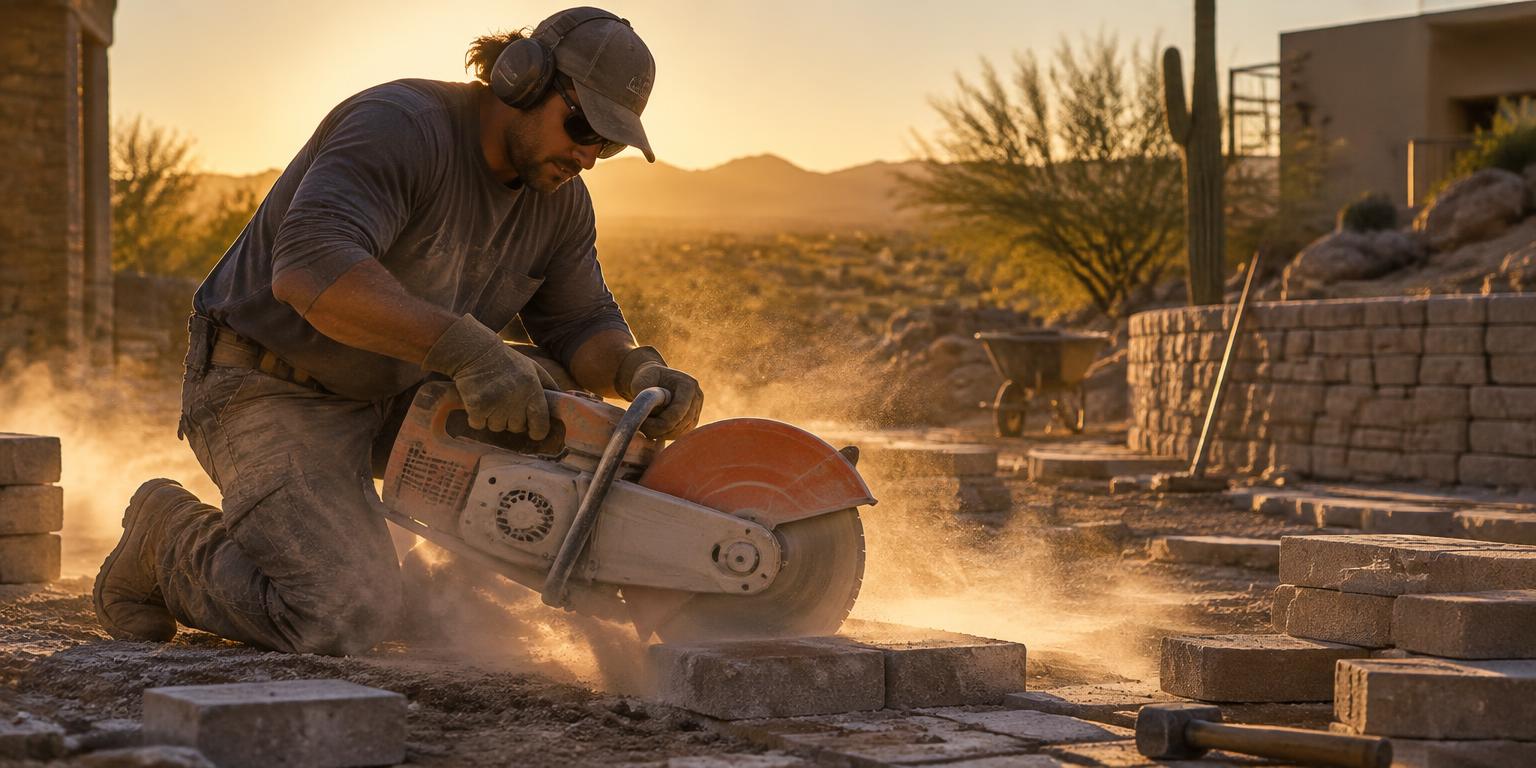
Customers do not always see the layout, excavation, elevation checks, base preparation, compaction, edge restraint, or hundreds of precise cuts. They do not see the dust, the equipment, or the 110-degree Arizona afternoon. They see the result because a trained crew handled every step that made it possible.
Our work demands knowledge across multiple disciplines:
- Drainage, elevations, and grading
- Soil conditions, excavation, and compaction
- Material selection, patterns, cuts, and tolerances
- Equipment operation and jobsite safety
- Installation standards and long-term performance
The better the crew, the more effortless the finished work appears. That is not evidence that the work is easy. It is evidence that the craftsperson knows exactly what they are doing.
Are You Actually Making Money on the Job?
Winning a project means nothing if the price cannot support the company that must deliver it. A contractor must calculate the full cost of doing professional work, not merely cover an installer's hourly wage and hope something remains.
Maybe you have looked at a project and thought, “If I do not install it for $2.50 a square foot, somebody else will.” Maybe they will. The better question is whether a professional company can consistently perform the work at that number and still be there when the customer needs it.
A sustainable price must account for costs such as:
- Wages, payroll taxes, workers' compensation, and insurance
- Trucks, trailers, fuel, equipment, repairs, blades, and tools
- Office staff, estimating, project management, and marketing
- Training, safety, callbacks, and warranty work
- Replacing the truck, skid steer, compactor, or saw worn out on the job
If the estimate leaves those costs out, the company is not cheaper because it found a better way. It is borrowing from its employees, equipment, future customers, or owner to subsidize today's project.
Profit Is What Lets a Contractor Stand Behind the Work
Profit is not a dirty word or an optional reward. It is the reserve that lets a contractor honor warranties, improve the company, keep good people, and answer the phone years after the project is complete.
Profit buys better equipment and pays for training. It creates careers instead of temporary jobs, makes raises possible, and gives the company enough strength to correct a mistake without risking payroll.
A profitable contractor can make decisions for the long term instead of surviving one week at a time. That stability serves the customer, the crew, the owner, and the reputation of the entire industry.
Racing to the Bottom Hurts the Entire Trade
This is not about price fixing; every company must set its own rates. It is about knowing your numbers well enough to compete on value rather than accidentally teaching customers that professional hardscape installation should be cheap.
Every contractor has different overhead, production rates, equipment, crews, and business models. Competition is healthy. But there is a major difference between competing responsibly and undervaluing the trade because “that is what everybody else charges.”
When skilled installation is treated like commodity labor, predictable problems follow:
- Good installers leave for better-paying work
- Companies cut training, safety, and quality controls
- Corners get cut and failures become more common
- Customers lose the ability to distinguish professional work from a low bid
- Responsible contractors must defend the real cost of doing the job correctly
The entire industry pays for poor pricing long after a single underpriced job is finished. The lowest number can become the expectation, while the callbacks and failures become everybody's reputation.
What We Build Deserves Professional Respect
Hardscape contractors create long-lasting spaces that shape homes, businesses, and communities. The people who produce that work deserve careers, training, safe conditions, and businesses strong enough to survive slow seasons and unexpected failures.
Drive through Arizona or New Mexico and look around. Somebody built those patios, retaining walls, driveways, and outdoor living spaces. Somebody spent days in the heat turning dirt, concrete, and stone into something a family may enjoy for the next 20 years.
That work should make us proud, and pride should change how we operate. We should be developing craftspeople, teaching installation standards, improving safety, and paying enough for talented people to see hardscaping as a legitimate career.
Strong companies can survive recessions, warranty claims, equipment failures, and slow seasons. We should stop apologizing for building those companies and making a fair profit while doing exceptional work.
Know Your Numbers Before You Name Your Price
No association or competitor can tell you the right price for your company. Your responsibility is to know the true cost of producing the project correctly and the profit required to keep your company healthy.
I am not going to tell you what to charge per square foot. That is your business. But I will challenge you to understand what every square foot actually costs before you send the estimate.
If you have done the math and are comfortable with your number, stand behind it. If you are pricing a job only because “that is what everybody else charges,” you may be building somebody else's dream while slowly destroying your own business.
Every Estimate Should Account for the Whole Business
A reliable estimate includes more than direct labor and materials. It must carry its fair share of overhead, risk, future replacement costs, and profit, or the number is incomplete.
Before setting a price, know:
- Direct labor and labor burden
- Materials, freight, and waste
- Overhead and office costs
- Equipment ownership, operation, and replacement
- Callbacks and warranty exposure
- Customer acquisition costs
- True gross profit and net profit
Those figures give you the confidence to explain your price and walk away from work that cannot support the standard you promise. Guessing may win a job, but accurate costing builds a company.
Profitable Competitors Make the Industry Better
The contractor across town does not have to be your enemy. Good, profitable competitors raise customer expectations, create better careers, and make it easier for every professional contractor to compete on craftsmanship rather than desperation.
I want competitors who train their employees, follow installation standards, answer their phones, stand behind their work, and charge enough to still be around when a customer needs them. Those companies make our entire industry stronger.
We can compete hard for a project and still shake hands afterward. The healthiest market is one where contractors compete on craftsmanship, professionalism, design, communication, reliability, knowledge, and customer experience—not on who can reach the bottom first.
When more contractors are profitable, more employees receive real training and more installers see hardscaping as a worthwhile career. Customers also learn the difference between having pavers placed and having a professionally constructed hardscape.
Before You Send the Next Estimate, Defend the Craft
Stop for five minutes before sending the next price and ask whether it supports the work, the people, and the promises behind it. You do not have to be the most expensive contractor, but you do have to understand your value and charge enough to build a real business.
Look at the estimate and ask:
- What is my craftsmanship actually worth?
- What does it cost to produce this project correctly?
- Am I charging enough to take care of my employees?
- Am I charging enough to stand behind my work?
- Am I charging enough to reinvest in my company?
- Am I charging enough to still be here ten years from now?
If the work requires this much knowledge, risk, equipment, physical effort, and craftsmanship, we should stop giving it away. Build it correctly. Stand behind it. Take care of your people. Never be ashamed of making a profit for producing exceptional work.
Our industry deserves sustainable companies. Our employees and families deserve them. Our customers deserve contractors who will still be here tomorrow, and the craftspeople who come after us deserve an industry worth joining.
David Bell
President, Southwest Hardscapes Association